

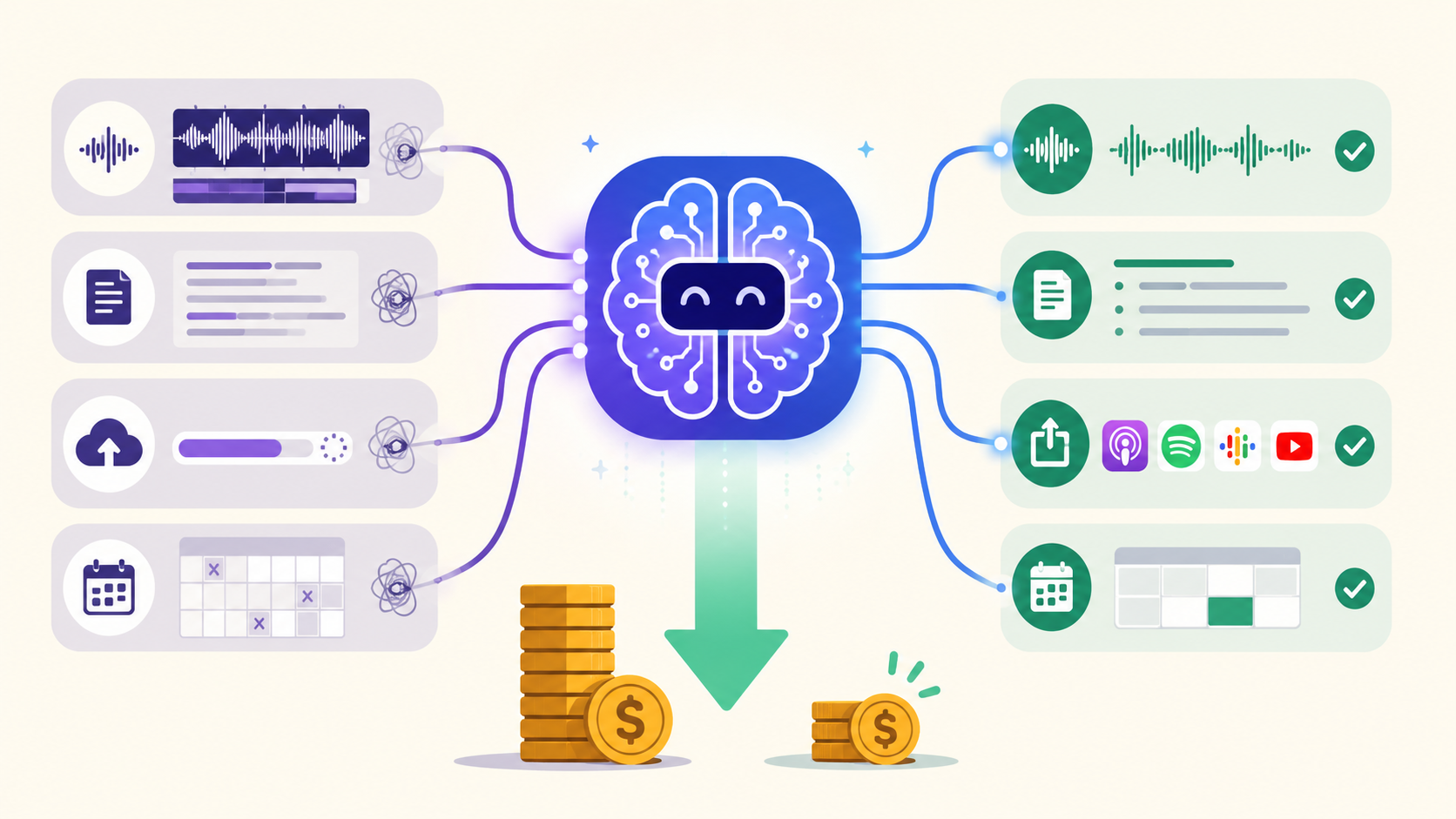
Podcast production costs have traditionally created barriers for independent creators and stretched budgets for established networks. Manual editing, professional transcription services, and time-intensive optimization processes can consume thousands of dollars per episode. The rise of artificial intelligence promises to democratize podcast creation by automating expensive manual tasks, but the real question centers on measurable cost reduction and improved production efficiency.
AI transforms podcast economics through two distinct pathways: direct cost reduction via automation and strategic cost optimization through data-driven decisions. While automated editing and transcription tools deliver immediate savings, the deeper value emerges when AI analyzes audience behavior to guide production investments. Understanding which content resonates with listeners prevents expensive missteps and maximizes every dollar spent on production, marketing, and distribution.
The podcast industry generates over $2 billion annually, yet many creators struggle with production costs that can range from $500 to $5,000 per episode depending on quality standards and professional services. AI adoption addresses this challenge by replacing expensive human labor with sophisticated algorithms while providing analytical insights that optimize resource allocation. The combination creates a compounding effect where lower direct costs meet smarter strategic decisions.
Direct Cost Reduction Through Production Automation
AI-powered editing tools represent the most immediate cost-saving opportunity for podcast producers. Traditional editing requires skilled audio engineers who charge $50-150 per hour for services that can take 3-8 hours per episode. Machine learning algorithms now handle noise reduction, level balancing, and basic editing tasks with accuracy levels approaching professional standards while operating at a fraction of the cost.
Transcription services demonstrate another area where AI delivers substantial savings. Professional human transcription costs $1-3 per minute of audio, meaning a typical 60-minute podcast episode requires $60-180 in transcription fees. Modern AI transcription services deliver 95%+ accuracy rates for $10-20 per hour while generating searchable text within minutes rather than days.
Content optimization through AI further reduces production costs by automating metadata creation, show note generation, and social media content development. These tasks traditionally require 2-4 hours of additional work per episode when handled manually. AI systems analyze episode content to generate compelling descriptions, extract key quotes, and create promotional materials automatically, eliminating the need for dedicated content specialists.
- Automated audio editing: AI removes background noise, balances levels, and handles basic cuts, reducing editing time from hours to minutes
- Instant transcription: Machine learning generates accurate transcripts at 90% lower costs than human services while delivering results immediately
- Content generation: AI creates show notes, social media posts, and episode descriptions automatically from audio analysis
- Quality enhancement: Algorithmic audio processing improves sound quality without expensive studio equipment or professional engineering
The cumulative effect of these automation technologies can reduce per-episode production costs by 60-80% compared to traditional manual processes. A podcast that previously cost $800 per episode to produce professionally might drop to $160-320 through strategic AI implementation. These savings scale significantly for networks managing multiple shows, creating budget flexibility for content expansion or marketing investments.
Listener's approach to production efficiency extends beyond basic automation by analyzing which production elements actually influence audience engagement. The team at Listener found that certain expensive production techniques show minimal correlation with listener retention, allowing producers to redirect budgets toward elements that demonstrably improve audience satisfaction and growth metrics.
Strategic Cost Optimization Through Audience Intelligence
AI's deeper value proposition emerges through sophisticated audience analysis that guides production decisions and prevents costly content missteps. Traditional podcast production operates with limited feedback loops, forcing creators to guess which topics, formats, and guests will resonate with their audience. This uncertainty leads to expensive experiments that often fail to deliver measurable results or audience growth.
Advanced analytics platforms use machine learning to identify patterns in listener behavior that human analysis might miss. These systems track engagement across different content types, guest appearances, and episode formats to reveal which production investments generate the strongest audience response. Understanding these patterns allows producers to allocate budgets strategically rather than spreading resources across untested approaches.
Listener AI surfaces trends in audience behavior that directly impact production budget decisions. The platform analyzes listening patterns, completion rates, and engagement metrics to identify which content elements drive the strongest response. This intelligence helps producers focus expensive resources like guest fees, location recording, and specialized equipment on content types that demonstrably expand their audience.
- Content performance analysis: Machine learning identifies which topics and formats generate the highest engagement rates and audience retention
- Guest impact measurement: AI tracks how different guest appearances affect download patterns and subscriber growth to optimize booking budgets
- Format optimization: Algorithms analyze listener behavior across episode lengths and structures to identify the most cost-effective production approaches
- Timing intelligence: AI determines optimal release schedules and frequency that maximize audience growth without unnecessary production overhead
The financial impact of data-driven production decisions often exceeds direct automation savings. A network that previously spent $10,000 monthly on guest fees might discover that certain guest categories drive 3x higher engagement rates, allowing them to redirect their budget toward high-impact bookings rather than spreading costs across lower-performing appearances. This strategic optimization can improve ROI by 200-400% while maintaining or reducing total production costs.
Listener's development team has observed that podcasters using comprehensive audience intelligence reduce their customer acquisition costs by an average of 45% compared to those relying on intuition-based production decisions. The Unified Network Dashboard pulls data from multiple platforms to reveal cross-channel audience behaviors that inform both content creation and budget allocation strategies.
Long-term ROI and Scalability Benefits
AI adoption creates compounding cost advantages that intensify over time as systems learn from accumulated data and production processes become increasingly automated. Initial setup investments in AI tools and analytics platforms typically pay for themselves within 3-6 months through reduced labor costs and improved content performance. However, the long-term benefits extend far beyond immediate expense reduction.
Scalability represents AI's most significant economic advantage for growing podcast operations. Manual production processes create linear cost increases as networks expand their content offerings, but AI systems handle additional shows with minimal marginal expense increases. A network that automates core production workflows can often double their content output while increasing costs by only 20-30%, dramatically improving their revenue potential per dollar invested.
Listener's data shows that podcast networks implementing comprehensive AI-driven production and analytics workflows achieve 60% higher profit margins within their first year compared to traditionally-operated competitors. The combination of reduced direct costs, optimized content investments, and improved audience targeting creates sustainable competitive advantages that strengthen over time as AI systems accumulate more behavioral data.
- Exponential efficiency gains: AI systems become more accurate and efficient as they process additional episodes and audience data
- Reduced quality variance: Automated systems maintain consistent production standards without the performance fluctuations common in manual workflows
- Predictive budget planning: Machine learning forecasts audience growth and engagement trends to enable more accurate financial planning and resource allocation
- Market expansion opportunities: Lower production costs and higher efficiency enable networks to experiment with new formats and audiences without prohibitive financial risk
The most successful podcast operations view AI implementation as infrastructure investment rather than simple cost-cutting. These organizations use automation savings to fund content experimentation, audience research, and market expansion that would be financially impossible under traditional production models. The resulting revenue growth often exceeds initial production cost savings by 5-10x within 18 months.
Custom Forms & Inbox features within modern analytics platforms enable automated audience feedback collection that further optimizes production decisions. The experts at Listener emphasize that sustainable cost reduction emerges from understanding audience preferences deeply enough to create content that naturally generates strong engagement and organic growth, reducing expensive marketing and acquisition requirements.